The deliberate manufacture of deformity
The Man Who LaughsThe deliberate manufacture of deformity is the systematic alteration of children’s bodies to produce people fitted for public amusement or political convenience. In the novel, it is not a freak occurrence or a natural variation: it is a practice with specialists, procedures, and customers. Its central contradiction is that a body made to entertain others carries a life and an inward self that the spectacle cannot disclose. Gwynplaine’s fixed smile gives that contradiction its most consequential form: the crowd reads laughter on his face while the person behind it does not share the expression.
The craft and its market
The narrator places the practice within a society that treats childhood as a period in which a person can be shaped for other people’s use. A child must be taken young, the account argues, because the intended result depends on intervening before the body has finished developing. A naturally formed child is described as less entertaining to the people who want a human novelty; the preference for deformity exposes the audience’s appetite as the motive behind the craft.
The work is presented as an organized art rather than an isolated act. Practitioners are said to have rules and specialized knowledge for changing a face, restricting growth, or producing the bodily features that make a person appear unusual. The narrator characterizes this work as the inverse of practices intended to restore or correct bodily form: instead of bringing the body toward an established ideal, the makers deliberately redirect its development. The language of skill and science is sharply ironic. Technical competence does not make the practice humane; it makes the production of an imposed condition more deliberate and repeatable.
The passage places this treatment of people within a broader claim about human beings altering nature for display. It briefly compares the shaping of human bodies with the production of piebald horses and the coloring of dogs, examples that make the underlying impulse visible: living bodies become material on which their owners or makers impose a desired appearance. The comparison does not erase the difference between animals and children. Rather, it emphasizes the unsettling social attitude that allows both to be treated as objects of fashionable invention.
Methods and effects
The Comprachicos are described as capable of producing markedly different results. They could leave a child’s spine straight while changing the face, or alter the joints of children intended for acrobatic performance. The account presents their procedures as adaptable to the outcome sought, not as a single uniform operation. This variety helps explain why the practice could serve several kinds of public entertainment: the desired body was made to fit a role.
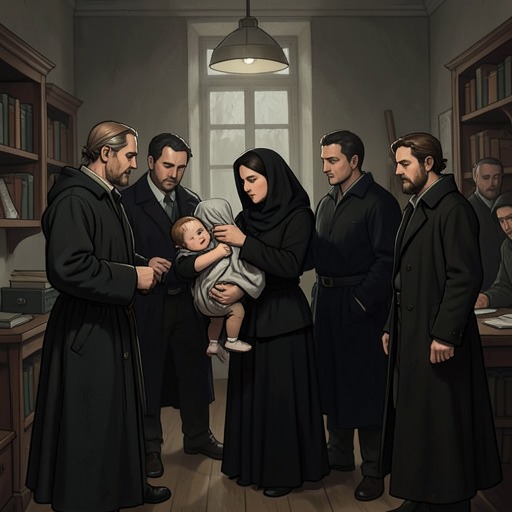
The account also stresses that the child might retain little or no conscious memory of what had been done. The Comprachicos used a stupefying powder, described as suppressing pain and awareness, and the child might later remember only being seized, falling asleep, and waking as if recovering from an illness. The gap between visible consequence and remembered experience is central to the horror of the system. The body bears the result, while the person may have no understanding of its cause. The narrator relates this method to knowledge associated with China, then describes a separate Chinese practice in which a young child is kept for years in a shaped porcelain vessel so that the body grows into its contours. In both examples, prolonged control of development is made to serve a maker’s chosen design.
Political use
The novel gives the practice a place within court politics as well as popular entertainment. Under the Stuarts, the Comprachicos are said not to have been wholly excluded from court favor; under James II, they could serve reasons of state. In a period when a family’s inheritance or succession might be disrupted, disfigurement offered a way to remove an heir from ordinary social life without killing him. A visibly altered person could be made to appear a performer or curiosity, and so pass through public spaces without the same suspicion that a concealed identity might attract.
This political use depends on the permanence of the imposed appearance. The narrator contrasts an external mask that can be removed with a face altered by the makers: the latter accompanies the person wherever he goes. The distinction turns bodily alteration into a form of political concealment. The technique does not merely change how a person looks; it can obscure who he is and interfere with recognition of his place in a family. Its apparent usefulness to power rests on the possibility that a human identity can be hidden in plain sight.
Gwynplaine as the defining instance
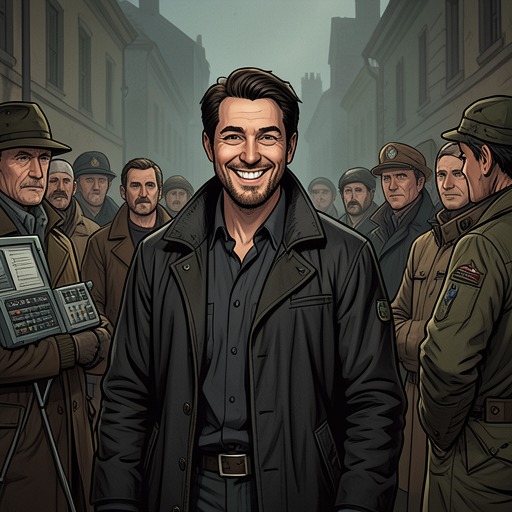
Gwynplaine’s face is the novel’s clearest individual instance of this manufactured spectacle. When the narrator finally turns from Gwynplaine’s actions to his appearance, his features are described as producing an expression of laughter so extreme that people who see him cannot easily look without laughing. His body, however, is tall, well formed, and agile; the alteration is concentrated in his face. The contrast supports the suspicion that his appearance is the result of human workmanship rather than nature acting alone.
The face functions independently of his feelings. Gwynplaine does not choose the expression, cannot remove it, and cannot prevent emotion from intensifying its appearance. Suffering, anger, pity, or astonishment may all make the face seem more hilariously contorted to onlookers. If he weeps, the spectators still see laughter. His professional success as a mountebank therefore depends on a response that is involuntary for him and automatic for his audience. People laugh, then turn away; women in particular recoil once the novelty of the laugh has passed. The same feature that brings him renown also makes him difficult for others to contemplate.
Meaning and narrative role
The manufactured smile becomes more than a mark of individual difference when Gwynplaine addresses the House of Lords. He identifies his expression as the consequence of a king’s action and presents it as an image of a population whose capacities and rights have likewise been deformed by its rulers. The speech makes the body a political argument: the face appears to smile, but its meaning, as Gwynplaine insists, is suffering and enforced silence. The crowd’s laughter at his appearance repeats the failure he condemns, as spectators respond to the surface while ignoring the person and history beneath it.
The novel thus connects the craft’s two uses. In the earlier account, specialists alter children so that other people can consume their bodies as entertainment or exploit their altered identities for political ends. In Gwynplaine’s life, the permanent smile remains a source of public amusement even when it conceals a different inner state; in the Lords, he turns that visible mismatch into an accusation against power. The deliberate manufacture of deformity names both the process that creates the spectacle and the social arrangement that keeps reading a person through it.